9 Common Deck Building Mistakes (And Why a Local Deck Builder Prevents Them)
After one freeze-thaw winter in Star, a deck built on the wrong footings can shift, crack, or pull away from the house entirely. Idaho's cold nights and sun-baked summers punish weak construction. What looked solid in October can feel loose by April.
Whether you're hiring a deck builder or thinking about going it alone, knowing the most common deck mistakes can save you thousands in repairs. It can also protect your family from real safety risks. A qualified local deck builder prevents these problems before they start.
Below, we walk through the nine mistakes we see most often on rebuilds and repairs across the Treasure Valley. From skipped permits to wrong fasteners, we explain what proper construction looks like at each step.
What Are the Most Common Deck Building Mistakes?
The most common deck building mistakes are:
- Skipping permits and inspections
- Installing inadequate footings
- Attaching the ledger board incorrectly
- Using the wrong joist spacing or size
- Choosing the wrong fasteners or lumber
- Ignoring water drainage and flashing
- Building railings that don't meet code
- Constructing unsafe stairs
- Underestimating future maintenance access
Most of these errors stay hidden until the deck fails. That's why hiring a licensed deck builder familiar with local codes is the safest, most cost-effective path for most homeowners.
Skipping Permits and Inspections
Deck building is regulated work, not a casual weekend project. Most cities, including Star and the rest of Ada County, require a permit for decks over 30 inches above grade or attached to your home. Skipping that step puts your project, your home sale, and your insurance at risk.
Unpermitted decks cause real problems down the road. They can derail home sales when buyers' inspectors flag them. They can also void homeowner's insurance claims if someone gets hurt or the deck fails.
Inspections exist to catch structural errors before they become disasters. A second set of trained eyes spots problems you can't see from the surface. That protection is built into the price of a permitted job.
A licensed deck builder pulls permits as part of the work. When you hire us, we handle:
- Permit applications with the local building department
- Required inspections at each phase of the build
- Final sign-off so your deck is on the record
We've pulled permits across Ada and Canyon County for years. We know which questions inspectors ask and how to pass on the first visit.
Inadequate or Improperly Installed Footings
Footings are the most common point of failure on a deck. They carry every pound of weight down into the ground. When they shift, the whole structure shifts with them.
Idaho's frost line typically runs 24 to 30 inches deep. Footings must extend below that line to prevent frost heave. Surface-set blocks or shallow pours move dramatically with each freeze-thaw cycle. That movement cracks concrete, twists framing, and pulls the deck out of square.
Footing size also matters. Concrete footings need to be sized for the deck's actual load, not eyeballed on the spot. A small deck and a large covered deck need very different footings. Soil type changes the math too. Sandy soil drains well but offers less bearing strength. Clay soil holds more weight but expands when wet.
For Star-area builds, we dig below the frost line and pour footings sized to the load and soil. We confirm depth and spacing with the inspector before any framing goes up. If your existing deck is settling or pulling away from the house, footing failure is often the cause. In those cases, a full
deck replacement service is usually safer than trying to patch the foundation.
Poor Ledger Board Attachment
The ledger board is the single most important connection on your deck. It ties the deck framing to your house. If the ledger fails, the deck falls, and most catastrophic deck collapses start right here. The American Wood Council has documented that
nail-only ledger connections are the leading cause of deck collapse in the United States.
Nails alone are not code-compliant for ledger attachment. Lag bolts or structural screws sized for the load are required. The fasteners must hit solid framing inside the wall, not just the siding or sheathing. Spacing and pattern matter as much as the bolt itself.
Flashing is the other half of the job. Without proper flashing, water runs behind the ledger and into the rim joist. That water rots the framing of both the deck and the house. The damage stays hidden for years until the wall feels soft or the deck starts pulling loose.
Two situations are major red flags on any deck:
- A ledger bolted into brick veneer instead of the structural frame
- A ledger fastened through siding with no flashing behind it
Our ledger process follows the code in order. We cut back the siding, install metal flashing that laps over the house wrap, set the ledger with structural fasteners into solid framing, and add a drip cap on top. That stack keeps water out and the deck tight to the house for the long haul.
Why Hiring a Local Deck Builder Pays Off
If those structural mistakes feel overwhelming, you're not alone. Most homeowners aren't equipped to spot them, let alone fix them mid-build. That's where a local deck builder earns their keep.
Local matters in this trade. A builder who works in Star and the wider Treasure Valley already knows the frost line, the soil types, and the seasonal moisture patterns that shape a good deck. We know which materials hold up to the August sun and the January cold. We also know the local building department and what each inspector wants to see.
Licensed and insured contractors carry liability that DIY work simply can't match. If something goes wrong on a permitted job, that coverage protects your home and your family. A weekend build leaves you holding the bill.
A pro saves money over the long run, even with the higher upfront cost. The savings come from:
- Avoiding rebuilds when DIY framing fails inspection
- Buying materials at trade pricing, not retail
- Cutting waste by ordering and cutting correctly the first time
- Skipping the cost of fixing water damage to the house years later
When you hire ATP Construction, the full job is handled. Permits, design, materials, build, and final walkthrough all run through one crew. We start with your vision, walk the site with you, build to code, and review the finished deck together before we leave. Our pricing stays transparent from the first conversation to the final invoice. We also handle professional deck repair and full replacements when an existing deck has reached the end of its life.
Incorrect Joist Spacing and Sizing
Joists carry the deck surface and everything on it. Get the spacing or size wrong, and the deck feels unsafe within a few seasons. This is math, not guesswork.
Joist spacing depends on the decking material you choose. Most composite boards require joists 16 inches on center for straight installations, and 12 inches on center for diagonal patterns. Standard wood decking often allows 16 inches on center for straight runs.
Undersized joists are the reason decks bounce, sag, and feel spongy underfoot. The IRC publishes span tables that set the maximum distance a joist can cover based on its size and species. Ignoring those tables is a code violation and a safety risk. A 2x8 covers a different span than a 2x10, and the wood species changes the numbers again.
Proper blocking and bridging adds rigidity between joists. Short pieces of lumber set perpendicular between long joists keep them from twisting. The deck feels solid, not springy.
If your deck bounces when you walk across it, the joists are likely undersized or spaced too wide. A bouncy deck is a warning, not a quirk. We size every joist to the span table and the chosen decking, then add blocking where the run gets long.
Using the Wrong Fasteners and Hardware
Small parts cause big failures on a deck. The wrong screw or nail can rot a connection out faster than most homeowners expect. By the time you see the damage, the framing is already compromised.
Modern pressure-treated lumber uses ACQ chemistry, which is hard on metal. Pressure-treated lumber requires hot-dipped galvanized or stainless steel fasteners. Standard nails or screws corrode quickly against ACQ wood, sometimes within a few seasons. The fasteners turn black, crumble, and lose their grip on the framing.
Joist hangers have their own rules. Each hanger must match the joist size exactly. They also need to be installed with the correct structural nails, not roofing nails or drywall screws. Roofing nails are too short and too soft for the load. We see this mistake on almost every DIY rebuild we touch.
Composite decking adds another layer. Hidden fastener systems require the specific brackets the manufacturer designed for that board. Generic clips often void the decking warranty.
Here is what the right hardware looks like on our builds:
- Hot-dipped galvanized or stainless lag bolts for the ledger
- Structural screws rated for ACQ-treated lumber
- Joist hangers sized to match each joist, set with structural nails
- Manufacturer-specified clips for composite decking
Choosing Inappropriate Lumber or Decking Material
The wrong decking material will undermine even the best framing. Idaho's climate swings from dry summer heat to wet winter freeze-thaw. Boards that work in mild climates can split, cup, or rot in Star within a few seasons.
Untreated lumber has no place on a deck. In ground contact or close to soil, untreated wood rots within a few seasons. Pressure-treated lumber is the standard for framing and ground-contact use. Even pressure-treated lumber comes in different grades. "Ground contact" is rated for posts and beams near soil, while "above ground" is meant for joists and decking that stay dry. Mixing them up shortens the life of the deck.
Cedar and redwood look beautiful and resist decay naturally. Both still need regular sealing in Idaho's dry summers to prevent splitting and gray weathering. Skip a season and the boards crack.
Composite decking handles freeze-thaw better than most natural woods. The trade-off is a higher upfront cost. Most homeowners come out ahead over 20 years thanks to lower maintenance.
For Star-area homes, we usually recommend one of two paths:
- Pressure-treated framing with composite decking for the lowest long-term maintenance
- Pressure-treated framing with cedar decking for a classic look, with a sealing schedule built in
We walk through the options on every
custom deck installation so the choice fits your budget and your weekend plans.
Inadequate Waterproofing and Drainage
Water is the slow killer of decks. The damage shows up years after the build, long after the original installer is gone. By then, the rot is often inside the framing or the wall of your house.
The most common drainage mistakes we find on rebuilds:
- Missing or wrong flashing at the ledger, letting water into the rim joist
- Decking boards butted tight with no gap, trapping moisture between them
- No slope or ground drainage, causing water to pool under the deck
- Low decks built without ventilation, creating constant damp under the boards
Flashing at the ledger is non-negotiable. Without it, every rainstorm sends water behind the deck and into your house framing. The repair often means opening up siding and replacing rotted studs.
Decking boards need a small gap between them. The gap lets water drain through and air move underneath. Boards installed tight together hold water on the seams and rot from the edges in.
Ground drainage matters too. The dirt under the deck should slope away from the house. Standing water under a low deck breeds mold and rot in the framing above.
Composite decking warranties spell this out clearly. Trex and other manufacturers void coverage if drainage and ventilation are not built to spec. Doing it right the first time protects both the deck and the warranty.
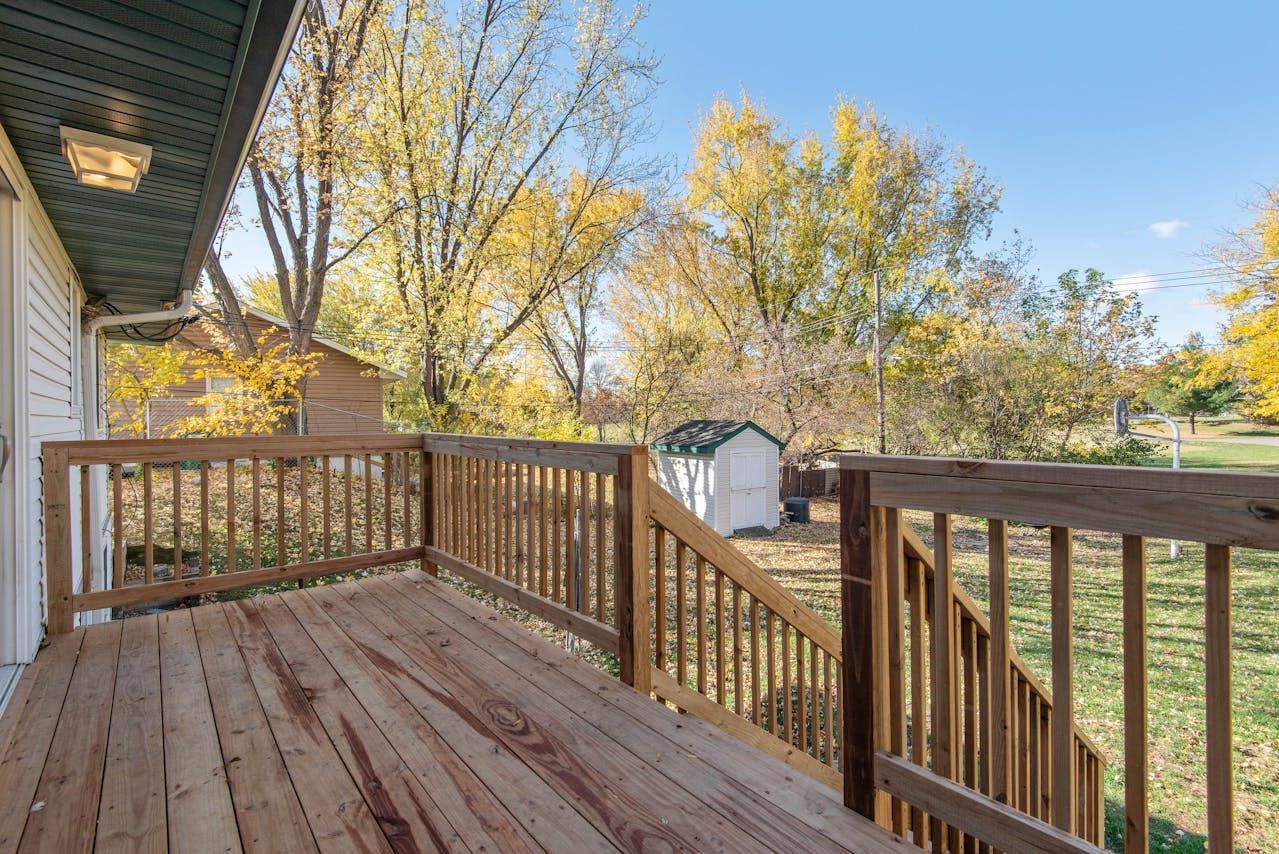
Incorrect Railing Installation
Railings are the most common code violation flagged on inspections. They are also the part of the deck people grab, lean on, and trust without thinking. Get them wrong and the safety risk is immediate.
Most jurisdictions require railings on any deck more than 30 inches above grade. The code is specific about strength and spacing:
- Top rail must withstand 200 pounds of horizontal force at any point
- Baluster spacing must not allow a 4-inch sphere to pass through
- Top rail height must be at least 36 inches for residential decks
- Posts must be properly anchored to the framing, not just notched into the rim joist
The 4-inch baluster rule exists for child safety. A toddler's head can fit through any gap larger than that. We see this missed on DIY railings all the time, especially on decorative designs with horizontal cables or wide patterns.
Post anchoring is the other frequent failure. A post simply notched into the rim joist relies on a few screws to hold 200 pounds of force. The right way uses through-bolts and dedicated post anchors that tie into the framing below. The post becomes part of the structure, not an add-on.
Loose railings often signal bigger problems below. If your top rail moves when you push it, the deck needs an inspection before the next gathering.
Unsafe Stair Construction
Stairs are where most deck injuries happen. They also fail more code inspections than any other part of the build. The rules are strict because uneven steps cause real falls.
Riser height has to stay uniform. Code allows no more than 3/8 of an inch of variation between the tallest and shortest riser in a flight. Anything more and your foot expects one height while landing on another. That mismatch is what trips people on stairs they've used a hundred times.
Tread depth and nosing matter just as much. Treads need to be deep enough for a full foot, with a consistent nosing that overhangs the riser. Skinny or inconsistent treads turn every trip down into a guess.
Stringers are the angled boards that carry the steps. They have to be sized correctly for the stair length and attached to the deck with the right hardware. Undersized stringers flex under load and pull the steps out of level over time.
A few rules that catch homeowners off guard:
- Handrails are required on any stair with four or more risers
- Handrails must be graspable, with a specific shape and size in the code
- Lighting is required at the top and bottom of most stair runs
- Landings at the top and bottom need to meet minimum size requirements
We build every stair to the IRC spec and test each riser before the boards go on. Uniform, solid, and lit — every time.
Why Hiring a Local Deck Builder Pays Off
If those structural mistakes feel overwhelming, you're not alone. Most homeowners aren't equipped to spot them, let alone fix them mid-build. That's where a local deck builder earns their keep.
Local matters in this trade. A builder who works in Star and the wider Treasure Valley already knows the frost line, the soil types, and the seasonal moisture patterns that shape a good deck. We know which materials hold up to the August sun and the January cold. We also know the local building department and what each inspector wants to see.
Licensed and insured contractors carry liability that DIY work simply can't match. If something goes wrong on a permitted job, that coverage protects your home and your family. A weekend build leaves you holding the bill.
A pro saves money over the long run, even with the higher upfront cost. The savings come from:
- Avoiding rebuilds when DIY framing fails inspection
- Buying materials at trade pricing, not retail
- Cutting waste by ordering and cutting correctly the first time
- Skipping the cost of fixing water damage to the house years later
When you hire ATP Construction, the full job is handled. Permits, design, materials, build, and final walkthrough all run through one crew. We start with your vision, walk the site with you, build to code, and review the finished deck together before we leave. Our pricing stays transparent from the first conversation to the final invoice. We also handle professional deck repair and full replacements when an existing deck has reached the end of its life.